
Guidance
Starting a Rambling club
The first steps
Forming a rambling club is often seen as rather daunting, but it needn’t be. If you already have a set of walkers that have met regularly it might involve as little as setting up a virtual or in-person meeting to choose a committee of may be three people and deciding on issues such as annual contributions, a walk programme, affiliation to the Federation, insurance, outings etc.
If you want to set up a new local rambling group and or expand your membership with like-minded people a few of the following suggestions might help.
- Organise a suitable venue, date and time for a meeting. Virtual meetings on Zoom or Microsoft-Teams are a useful alternative and save people transport costs and time.
- A few weeks before, leave some leaflets giving details of venue, date and time in the local Library / Town Hall / Tourist Centre / Sports Centre/ shops. In fact, anywhere where people are likely to glance at it and perhaps pick it up. Setting up a QR code may help.
- Advertise the meeting in local papers if there is one. They may be helpful and defray costs.
At your meeting
- Have a brief introductory talk from someone with experience of rambling and rambling groups outlining necessary equipment, fitness levels, and health benefits.
- Produce a brief questionnaire for immediate completion by those attending.
- Useful headings for completion might include details of Rambling/Hill-Walking or rambling experience, knowledge or interests possessed which might be useful to a rambling group, contact telephone numbers and e-mail addresses.
- Appoint, if possible on the night, a Chairperson, Secretary and Treasurer with a small committee of perhaps three.
- Discuss and arrange a few walks immediately, this gets the club moving and into the countryside. Use your experience to gauge what kind of rambling would be suitable for the age ranges and experience of those present.
For future meetings of the committee
- Draw up a Walks Programme incorporating dates, starting point grid references, starting times and approximate routes. Indicting the length in time and distance and level of ascent may be helpful for members to evaluate whether their fitness level is up to them completing the walk
- Appoint a walk leader(s), if possible, for each walk. Look at programmes of member clubs on the Federation’s website. This will suggest many possible walks.
- Produce a set of club rules e.g. minimum age / dogs or no dogs / Leave No Trace / Country Code / personal gear and equipment required etc.
- Set out some responsibilities of the leaders and more importantly the personal responsibilities of the members.
- Discuss club membership fee and insurance – joining the UFRC is a useful first step here.
- Aspects of training and possible grants might be considered.
- Get your programme published or printed. If you are lucky a local sports or outdoor shop might sponsor it. If not, there will always be someone who can produce an initial programme cheaply on a computer.
- Publicise your future walks in local papers – perhaps send in a report after your first walk. You will be surprised at how many inquiries will result from this.
For the future
- Produce ideas for the constitution for your club. Many existing clubs will be happy to share their one as a template to help drawing one up.
- Produce a database with details of members e.g. names, addresses, telephone numbers (landline or mobile), a contact number for emergencies, e-mail addresses.
- Think about producing a club newsletter or factsheet, perhaps quarterly. In the future you might have a straightforward member orientated website built and as your club grows this will be useful for communication and attraction of new members.
UFRC developed a Governance Guide for Walking/Hiking Clubs in 2025. The Guide helps clubs establish strong governance by forming a committee, creating a constitution, affiliating with the UFRC and aligning with its standards. It emphasises five key principles – clear roles, effective teamwork, purposeful planning, proper control and integrity. This detailed document offers guidance beyond basic expectations.
Access
The 11 district councils have powers and duties to enable access for outdoor recreation provided by the Access to the Countryside (Northern Ireland) Order 1983. The councils must assert any route that they determine is a public right of way. They can enter into agreements for public path creation. Waymarked ways also fall under the councils’ remit.
The councils’ also have a duty to keep maps of public rights of way within their jurisdiction. There are also discretionary powers to maintain pathways, erect signage, stiles and gates.
There is no right to roam on the island of Ireland.
For advice on where is open and accessible WalkNI.com includes a range of walks. Additionally, its sister site OutmoreNI.com includes other locations and parks.
If you are out walking and encounter any changes to the route or any issues, then please report this. WalkNI.com has a report a problem feature. However, if you report to the Federation, we can forward this matter on your behalf. By reporting it gives the relevant council/ government department time to act. In the Republic of Ireland, the organisation which oversees this is Keep Ireland Open. Any issues on the island of Ireland can be reported using the email link below.
Access Issue
Risk Assessments
Some clubs have sought advice on whether walk leaders should carry out and record formal risk assessments in advance of club walks. We are all aware of the potential hazards associated with hill walking, but it is also true that there are hazards associated with walking on cliff paths, forests, roads or near open water. The bottom line is that walking just about anywhere in the countryside can be hazardous if sensible precautions are not taken.
There is not one standard approach to risk assessments amongst our clubs. That is not surprising given the diversity of UFRC membership and the fact that some of our clubs engage in walks that are clearly more challenging than others.
The Executive Committee has considered this and concluded that we did not want to dictate to clubs what they should do regarding assessing risk. That said, we strongly recommend that walk leaders carry out a recce of the walk before the club walk takes place – unless the route is already well known to the leader. Among other things, this enables the leader to assess what hazards the group might encounter on the day and what precautions would be appropriate. It is a matter for clubs to decide whether this recce should involve a formal written assessment. It will depend in part on the nature of the walk and the skills and experience of those taking part.
We would recommend that clubs have a discussion on this subject to ensure that their members (and walk leaders) are content with current practices.
Risk assessments vary enormously in their degree of complexity. As a guide we are attaching below two examples which, although quite different, serve the same purpose. One is based on a form used by one of our clubs and the second is that which was used by walk leaders for the Walking in Your Community programme. There are many other examples to be found on the internet. If a club decides to carry out formal risk assessments for all or some of its walks, it should be able to produce a template based on one or a combination of these examples.
Should clubs wish to discuss this matter with any of the Committee members then feel free to contact us.
Example 1


Example 2

Leave No Trace
Take only memories, leave only footprints!
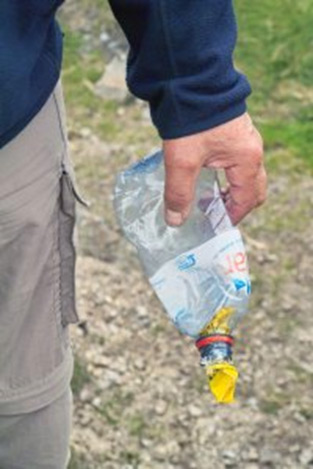
Unbelievably, some people throw down their empty plastic water bottles on the hills. Packed lunch litter is left at natural stop or shelter spots, and/or wrappers and cans are stuffed into cracks in rocks and stone walls. But Leave no trace is about more than litter!
The 7 Principles are:
- Plan Ahead and Prepare
- Be Considerate of Others
- Respect Farm Animals and Wildlife
- Travel and Camp on Durable Ground
- Leave What You Find
- Dispose of Waste Properly
- Minimise the Effects of Fire
You might think even your biodegradable waste is fine to leave but here is the truth:
- A paper towel takes 2-4 weeks to decompose
- An apple core takes 2 months to decompose
- Orange peel – 6 months to decompose
- Banana skin – 1-2 years to decompose
- Aluminium can – 50 to 100 years to decompose
- Polystyrene and plastics packaging – 400 years to decompose
- Plastic Water Bottles are estimated to require 450 years to decompose
… and that’s only if you bury it!
Be responsible and improve the situation by:
- Embracing an active ‘Leave No Trace’ policy.
- Pre-plan an identified ‘Banana Skin bag carrier’ for each walk in your calendar.
- Educate your group, when packing their Rucksack; to remove their paper and plastic shop wrapping from their sandwiches and snacks and replace with reusable packaging.
- Always bring a rubbish bag with you so that you can clean up after your snacks and lunch break. If you forget your rubbish bag, carry any leftover waste/wrappers into your rucksack and dispose of them either at home or when you come across a bin.
- Use your rubbish bag to lift ‘others discarded rubbish’ as you come across it. Help clean the hills as you walk.
- Adopt a no tolerance policy to members discarding food waste, even if it is biodegradable.
- Follow the example of the UFRC Clubs who undertake regular litter-collection walks included in their annual walking calendar.
- Campfires are discouraged. A cooking stove is more efficient and welcomed. In places where campfires are permitted, make sure your fire is small and safely contained, while ensuring the fire is completely extinguished when you leave it. Return the fire site to its original condition.
Practising a “Leave No trace” ethic is very simple:
“Make it hard for others to see or hear you and LEAVE NO TRACE of your visit”.